AstronautAtlas
Search the complete archive…
Loading AstronautAtlas records
Program archive
Across five qualification and operational flights—two uncrewed Soviet tests, the crewed Soyuz 16 rehearsal, Soyuz 19, and Apollo—the Apollo-Soyuz Test Project developed and proved the first compatible international crewed docking system.
Explore this program
Choose a path through the Apollo-Soyuz archive.

Across five qualification and operational flights—two uncrewed Soviet tests, the crewed Soyuz 16 rehearsal, Soyuz 19, and Apollo—the Apollo-Soyuz Test Project developed and proved the first compatible international crewed docking system.
Core capabilities
Program story
The Apollo-Soyuz Test Project grew from a 1972 space-cooperation agreement between the United States and Soviet Union. Engineers had to reconcile different spacecraft atmospheres, docking systems, languages, measurements, procedures, and mission-control practices.
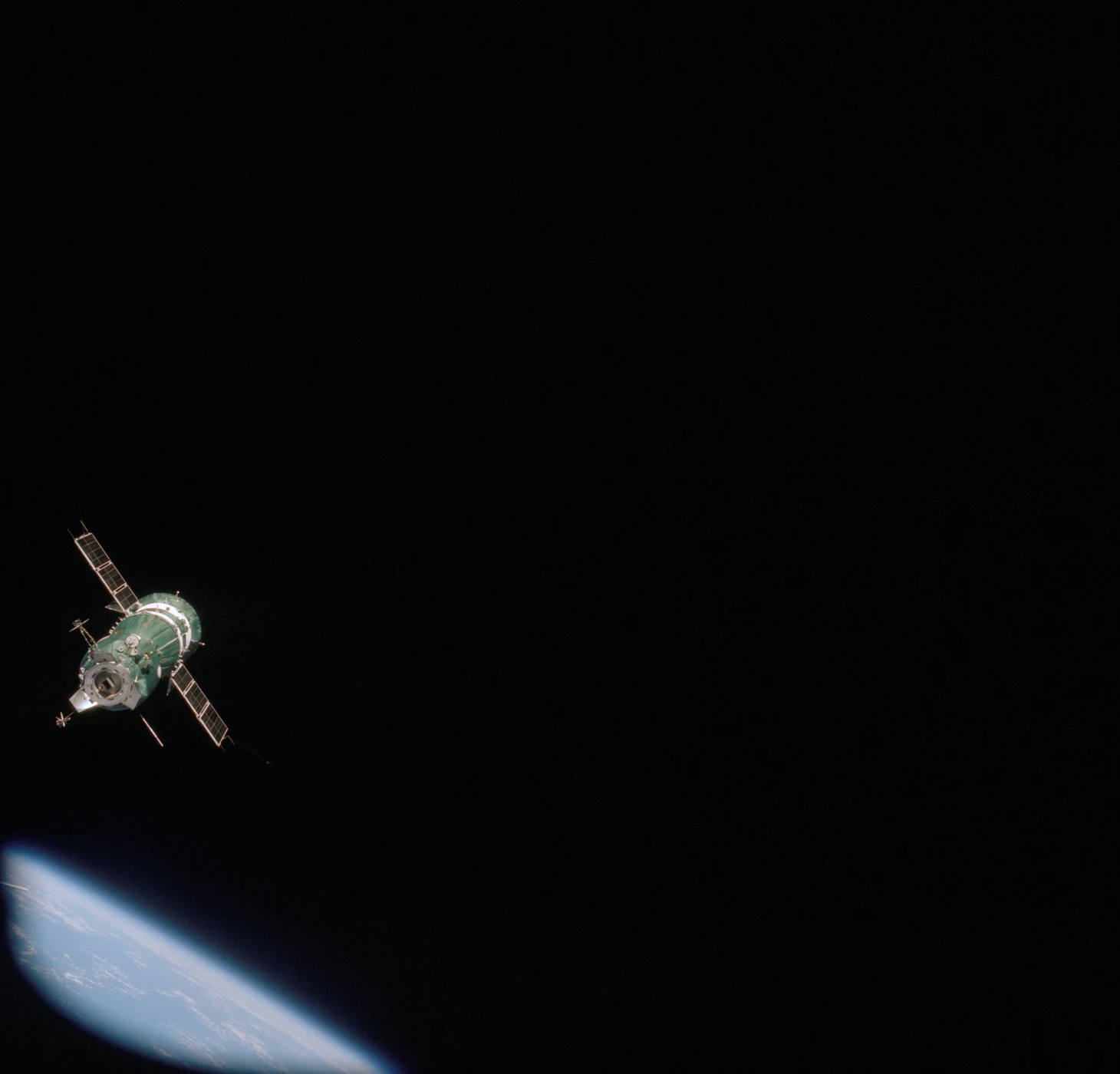
The Soviet Union qualified its modified Soyuz 7K-TM with the uncrewed Cosmos 638 and Cosmos 672 flights in 1974. Soyuz 16 then flew a six-day crewed dress rehearsal, testing the cabin-pressure changes, compatible communications, NASA tracking support, and APAS-75 docking hardware planned for the joint mission.
Soyuz 19 and Apollo launched separately on July 15, 1975. After two days of orbital maneuvering they docked, and the five crew members opened the hatches, exchanged greetings, conducted demonstrations and experiments, and moved between the two spacecraft.
The mission’s technical value centered on compatible rendezvous and docking, but its larger legacy was operational trust. The experience anticipated later Shuttle-Mir missions and the multinational work that became routine aboard the International Space Station.
Names, numbers, and patches
Apollo-Soyuz sources use several overlapping labels. This archive separates individual launches while preserving the names used in NASA histories, Soviet flight records, and later reference works.
NASA historical material notes that the final spacecraft were officially referred to simply as Soyuz and Apollo. Soyuz 19 became the standard identifying name for the Soviet flight, while Apollo 18 is a later unofficial label and is retained only as an alias. Cosmos and Kosmos are alternative English transliterations of the same Russian program name.
NASA Apollo-Soyuz mission and spacecraft history →