AstronautAtlas
Search the complete archive…
Loading AstronautAtlas records
Program archive
The complete Shuttle flight archive joins 16 Enterprise Approach and Landing Test events with all 135 orbital missions flown by Columbia, Challenger, Discovery, Atlantis, and Endeavour—from reusable-flight qualification to satellite deployment, orbital research, Shuttle-Mir, Hubble servicing, and International assembly.
Explore this program
Choose a path through the Space Shuttle archive.
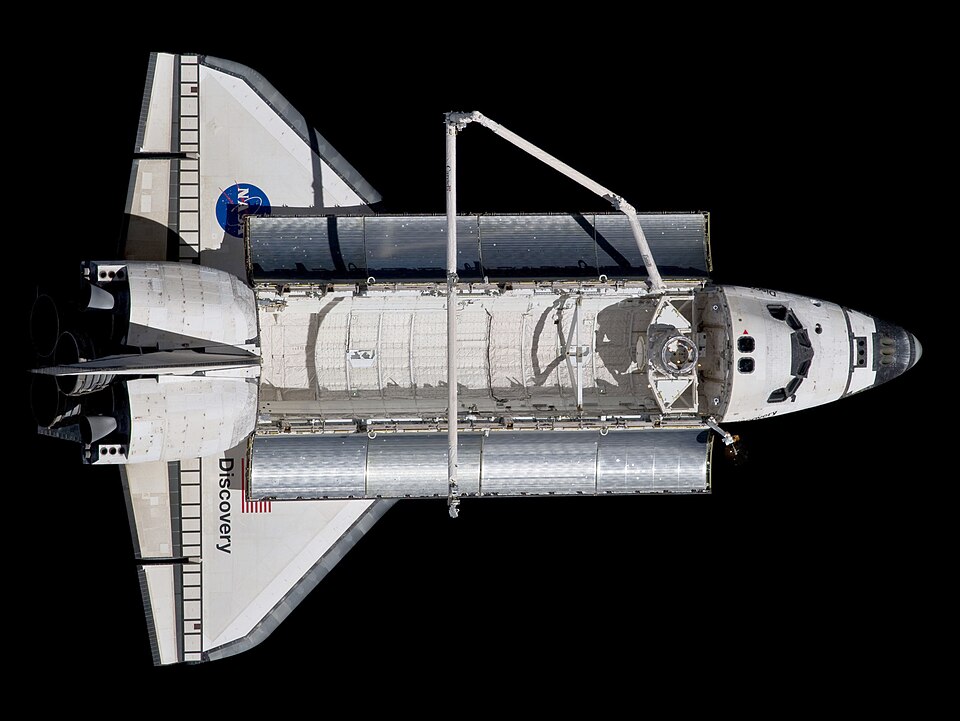
The complete Shuttle flight archive joins 16 Enterprise Approach and Landing Test events with all 135 orbital missions flown by Columbia, Challenger, Discovery, Atlantis, and Endeavour—from reusable-flight qualification to satellite deployment, orbital research, Shuttle-Mir, Hubble servicing, and International assembly.
Core capabilities
Program story
NASA developed the Space Transportation System to provide reusable access to low Earth orbit. Enterprise first put the full-scale orbiter shape, controls, carrier-aircraft combination, separation sequence, atmospheric handling, and unpowered landing profile through 16 Approach and Landing Test events in 1977: three taxi tests, five captive-inert flights, three captive-active flights, and five free flights.
The operational Shuttle launched as a complete stack: a reusable orbiter with three main engines, an expendable external tank, and two recoverable solid rocket boosters. In orbit the orbiter carried crew and payloads, maneuvered as a spacecraft, and then returned through the atmosphere for an unpowered runway landing.
Columbia opened the flight era with STS-1 in April 1981. Over 135 missions, the shuttle fleet deployed satellites and observatories, carried laboratories, serviced the Hubble Space Telescope, supported international cooperation with Mir, and delivered the majority of the large U.S. elements of the International Space Station.
The losses of Challenger on STS-51-L and Columbia on STS-107 reshaped the program and NASA’s approach to risk. Each was followed by investigation, redesign, and organizational change. Atlantis completed the final shuttle mission, STS-135, in July 2011.
Names, numbers, and patches
A Shuttle flight designation identified a planned mission, not necessarily its eventual place in the launch sequence. NASA changed systems after STS-9, then changed back after Challenger; assigned designations stayed with their paperwork through delays and manifest changes. Crew patches could compress, omit, or artistically arrange the formal designation while emphasizing the orbiter, payload, crew, or destination.
STS always meant Space Transportation System. The 1984–1986 code described the manifest NASA expected when it assigned the name; it was not a running count of flights. That is why STS-41-B followed STS-9, why STS-51-C launched before STS-51-B, why later flights such as STS-94 and STS-93 flew out of numerical order, and why a patch’s typography can differ from an official historical designation without representing a different mission.
NASA: Behind the Space Shuttle Mission Numbering System →